

50 Important Rules of Adverbs in English Grammar
Simple, Easy-to-Understand Guide for Better English Writing and Speaking
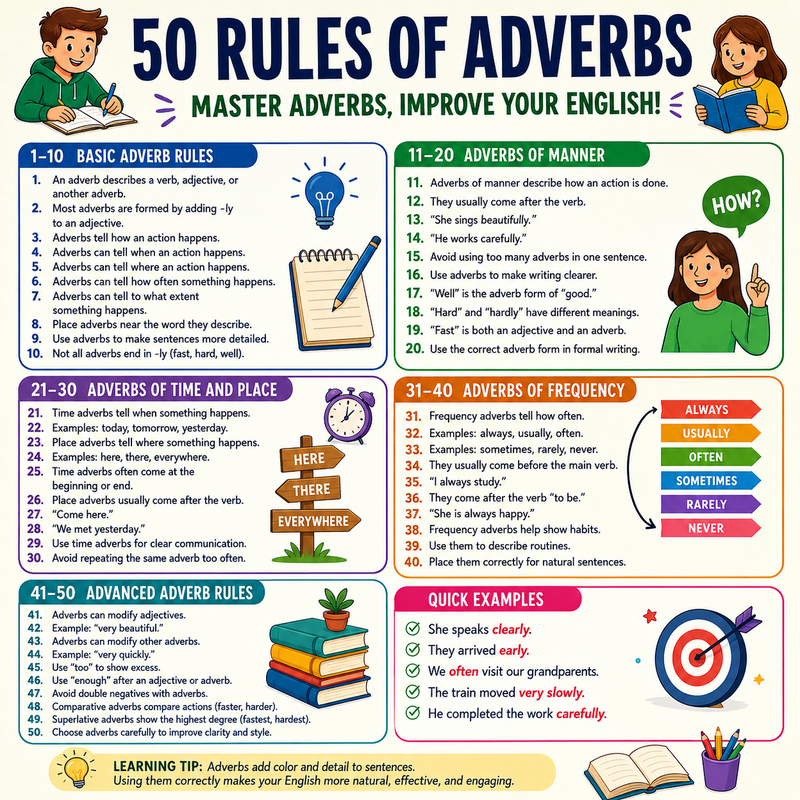

1–10: Basic Adverb Rules
An adverb describes a verb, adjective, or another adverb.
Most adverbs are formed by adding -ly to an adjective.
Adverbs tell how an action happens.
Adverbs can tell when an action happens.
Adverbs can tell where an action happens.
Adverbs can tell how often something happens.
Adverbs can tell to what extent something happens.
Place adverbs near the word they describe.
Use adverbs to make sentences more detailed.
Not all adverbs end in -ly (fast, hard, well).
11–20: Adverbs of Manner
Adverbs of manner describe how an action is done.
They usually come after the verb.
"She sings beautifully."
"He works carefully."
Avoid using too many adverbs in one sentence.
Use adverbs to make writing clearer.
"Well" is the adverb form of "good."
"Hard" and "hardly" have different meanings.
"Fast" is both an adjective and an adverb.
Use the correct adverb form in formal writing.
21–30: Adverbs of Time and Place
Time adverbs tell when something happens.
Examples: today, tomorrow, yesterday.
Place adverbs tell where something happens.
Examples: here, there, everywhere.
Time adverbs often come at the beginning or end.
Place adverbs usually come after the verb.
"Come here."
"We met yesterday."
Use time adverbs for clear communication.
Avoid repeating the same adverb too often.
31–40: Adverbs of Frequency
Frequency adverbs tell how often.
Examples: always, usually, often.
Examples: sometimes, rarely, never.
They usually come before the main verb.
"I always study."
They come after the verb "to be."
"She is always happy."
Frequency adverbs help show habits.
Use them to describe routines.
Place them correctly for natural sentences.
41–50: Advanced Adverb Rules
Adverbs can modify adjectives.
Example: "very beautiful."
Adverbs can modify other adverbs.
Example: "very quickly."
Use "too" to show excess.
Use "enough" after an adjective or adverb.
Avoid double negatives with adverbs.
Comparative adverbs compare actions (faster, harder).
Superlative adverbs show the highest degree (fastest, hardest).
Choose adverbs carefully to improve clarity and style.
Quick Examples
✅ She speaks clearly.
✅ They arrived early.
✅ We often visit our grandparents.
✅ The train moved very slowly.
✅ He completed the work carefully.
Learning Tip: Adverbs add color and detail to sentences. Using them correctly makes your English more natural, effective, and engaging. 📚✨

Comments
No comments yet. Be the first to comment!