

“English Tenses: The Foundation of Good Grammar”
Why Learning Tense is Important

Introduction
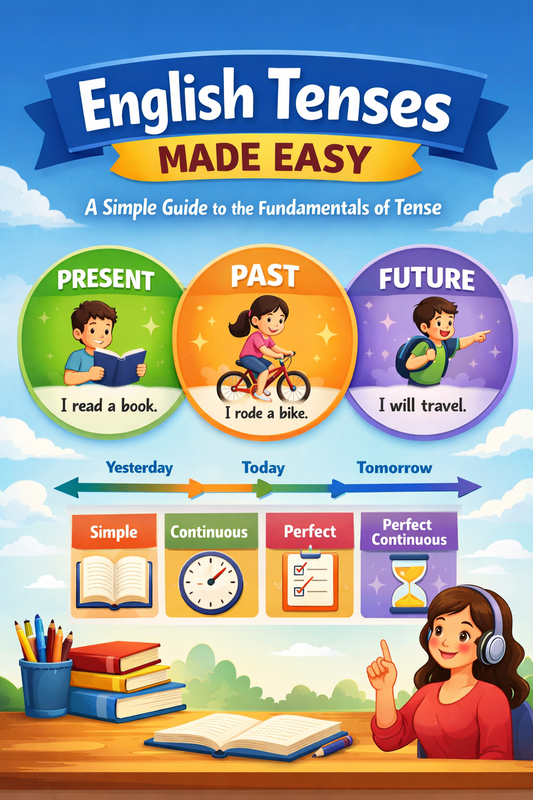
Tense is one of the most important parts of English grammar. It tells us when an action happens. When we speak or write, we use different forms of verbs to show whether the action happened in the past, is happening now, or will happen in the future. These verb forms are called tenses.
Understanding tense helps us speak clearly and correctly in English.
What is Tense?
A tense shows the time of an action in a sentenc Example:I play cricket. (Present)
I played cricket yesterday. (Past)
I will play cricket tomorrow. (Future)
In English, there are three main tenses:
Present Tense
Past Tense
Future Tense
Each tense also has four forms, which explain the action more clearly.
1. Present Tense
The present tense is used to talk about actions that happen now, regularly, or always.
Types of Present Tense
1. Simple Present
It describes daily habits, general truths, and routines.
Structure:
Subject + base verb
Examples:
I wake up early.
She reads books.
They play football.
2. Present Continuous
It describes actions happening right now.
Structure:
Subject + is/am/are + verb + ing
Examples:
I am studying English.
She is cooking food.
They are playing outside.
3. Present Perfect
It describes actions that have already happened but are connected to the present.
Structure:
Subject + has/have + verb (third form)
Examples:
I have finished my work.
She has written a letter.
They have visited the temple.
4. Present Perfect Continuous
It describes an action that started in the past and is still continuing.
Structure:
Subject + has/have been + verb + ing
Examples:
I have been studying for two hours.
She has been working since morning.
2. Past Tense
The past tense is used to talk about actions that already happened in the past.
Types of Past Tense
1. Simple Past
It describes a completed action in the past.
Structure:
Subject + verb (second form)
Examples:
I visited Jaipur last week.
She wrote a story.
They played cricket.
2. ContinuousPast
It describes an action that was happening at a particular time in the past.
Structure:
Subject + was/were + verb + ing
Examples:
I was reading a book.
She was cooking dinner.
They were playing in the park.
3. Past Perfect
It describes an action that happened before another action in the past.
Structure:
Subject + had + verb (third form)
Examples:
I had finished my homework before dinner.
She had left the house before it started raining.
4. Perfect ContinuousPast
It describes an action that continued for some time before another past action.
Structure:
Subject + had been + verb + ing
Examples:
I had been studying for two hours before the exam.
She had been working all day.
3. Future Tense
The future tense is used to talk about actions that will happen later.
Types of Future Tense
1. Simple Future
It describes actions that will happen in the future.
Structure:
Subject + will + base verb
Examples:
I will visit Delhi tomorrow.
She will call you later.
They will travel next week.
2. Future Continuous
It describes an action that will be happening at a certain time in the future.
Structure:
Subject + will be + verb + ing
Examples:
I will be studying tonight.
She will be working tomorrow.
3. Future Perfect
It describes an action that will be completed before a certain time in the future.
Structure:
Subject + will have + verb (third form)
Examples:
I will have finished the work by evening.
She will have reached home by 6 PM.
4. Future Perfect Continuous
It describes an action that will continue for some time before a certain moment in the future.
Structure:
Subject + will have been + verb + ing
Examples:
I will have been studying for three hours by 9 PM.
She will have been working here for five years next month.
Conclusion
Tense is the foundation of English grammar. It helps us express time clearly in our sentences. When we understand the three main tenses—present, past, and future—and their forms, we can speak and write English more confidently.
Learning tense may take time, but with practice and daily use, it becomes easier. Start with simple sentences and slowly move to more complex ones.
✅ Simple Tip:
If you want to improve your English, practice making sentences in different tenses every day.

Comments
No comments yet. Be the first to comment!