

Master English Tenses
100 Essential Rules to Speak and Write English Confidently
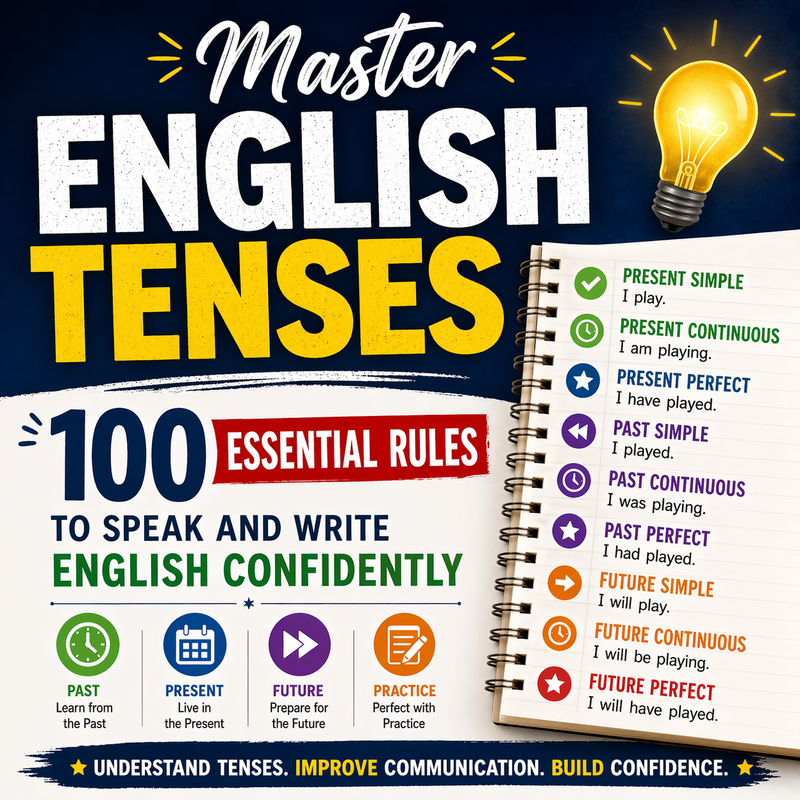

100 Essential Rules of Tenses in English Grammar
Mastering tenses is the key to speaking and writing English correctly. Here are 100 important tense rules explained in simple language.
Present Tense Rules
Use the simple present for daily routines.
Add s/es with singular subjects.
Plural subjects use the base verb.
Use do/does for questions.
Use do/does not for negatives.
Use present continuous for actions happening now.
Structure: am/is/are + verb + ing.
Use is with singular subjects.
Use are with plural subjects.
Use am with "I".
Use present perfect for completed actions with present results.
12.Structure: has/have + past participle
Use has with singular subjects.
Use have with plural subjects.
Use present perfect continuous for actions continuing until now.
Structure: has/have been + verb + ing.
Use since for a starting point.
Use for for a period of time.
Stative verbs usually do not take continuous forms.
Example: "I know the answer."
Past Tense Rule
Use simple past for completed past actions.
22.Add ed to regular verbs.
Irregular verbs have special forms.
Use did for questions.
Use did not for negatives.
Base verb follows did.
Use past continuous for ongoing past actions.
Structure: was/were + verb + ing.
Use was with singular subjects.
Use were with plural subjects.
Use past perfect for an earlier past action.
Structure: had + past participle.
Use past perfect continuous for duration before a past moment.
Structure: had been + verb + ing.
Use simple past with specific past time.
Example: yesterday, last week.
Past continuous often describes background action.
Simple past often interrupts past continuous.
Use "while" with past continuous.
Use "when" with simple past.
Future Tense Rules
Use simple future for predictions.
Structure: will + base verb.
Use "shall" mainly with I and we (formal).
Use "going to" for planned actions.
Use future continuous for ongoing future actions.
Structure: will be + verb + ing.
Use future perfect for completed future actions.
Structure: will have + past participle.
Use future perfect continuous for duration until a future point.
Structure: will have been + verb + ing.
Use present continuous for fixed future arrangements.
Use simple present for schedules.
Example: The train leaves at 6 PM.
Avoid using "will" after time clauses.
Use present tense after when, before, after, until.Subject-Verb Agreement Rules
Singular subject takes singular verb.
Plural subject takes plural verb.
"I" always takes the base verb.
Collective nouns may be singular.
Indefinite pronouns are usually singular.
Everyone, someone, nobody take singular verbs.
Either/or agrees with the nearest subject.
Neither/nor follows the same rule.
Titles of books are singular.
Amounts of money are singular.
Time Expressions
Use simple present with always, often, usually.
Use present continuous with now, currently.
Use simple past with ago, yesterday.
Use present perfect with already, yet, just.
Use present perfect with ever and never.
Use future with tomorrow, next week.
Use since with a point in time.
Use for with a duration.
Use by with deadlines.
Use until for continuation.
Common Error Rules
Never use two past markers together.
Incorrect: Did you went?
Correct: Did you go?
After has/have, use past participle.
After will, use base verb.
After modal verbs, use base verb.
Avoid using present tense for completed past actions.
Use past perfect only when comparing two past actions.
Do not overuse continuous tenses.
Stative verbs rarely use continuous forms.
Advanced Tense Rules
Sequence of tenses matters in reported speech.
Universal truths stay in present tense.
Conditional sentences follow special tense patterns.
Zero conditional uses simple present.
First conditional uses present + will.
Second conditional uses past + would.
Third conditional uses past perfect + would have.
Mixed conditionals combine time references.
Use subjunctive in formal wishes.
Example: If I were you.
Literary writing may shift tenses intentionally.
Maintain tense consistency in paragraphs.
Avoid unnecessary tense changes.
Context determines the correct tense.
Practice is the best way to master tenses.

Comments
No comments yet. Be the first to comment!