

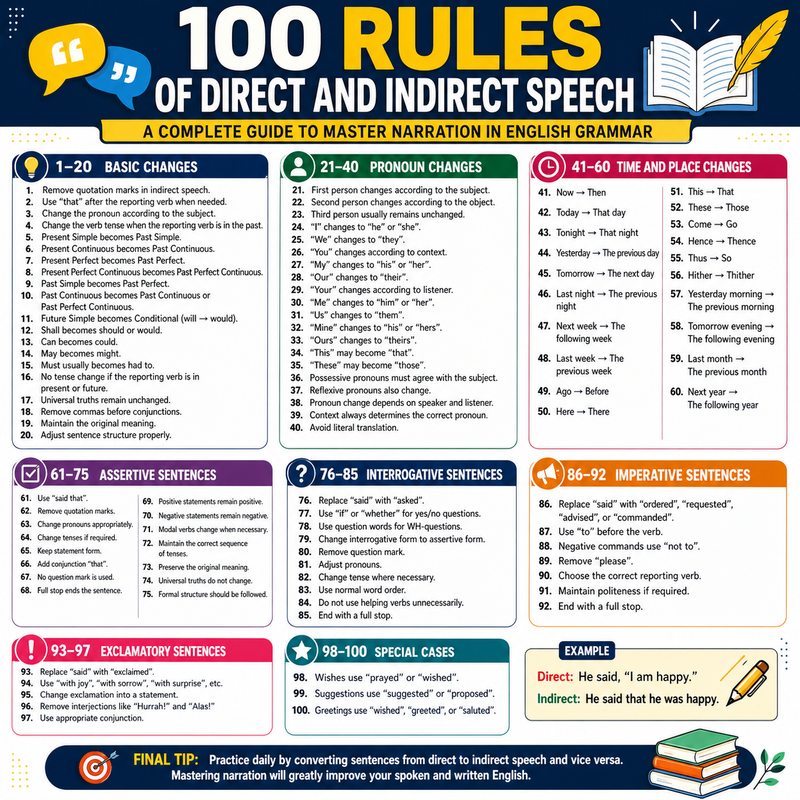
100 Rules of Direct and Indirect Speech
A Complete Guide to Master Narration in English Grammar

Introduction
Direct Speech repeats the exact words spoken by a person. Indirect Speech reports what someone said without quoting their exact words.
Example:
Direct: He said, "I am happy."
Indirect: He said that he was happy.
Rules 1–20: Basic Changes
Remove quotation marks in indirect speech.
Use "that" after the reporting verb when needed.
Change the pronoun according to the subject.
Change the verb tense when the reporting verb is in the past.
Present Simple becomes Past Simple.
Present Continuous becomes Past Continuous.
Present Perfect becomes Past Perfect.
Present Perfect Continuous becomes Past Perfect Continuous.
Past Simple becomes Past Perfect.
Past Continuous becomes Past Continuous or Past Perfect Continuous.
Future Simple becomes Conditional (will → would).
Shall becomes should or would.
Can becomes could.
May becomes might.
Must usually becomes had to.
No tense change if the reporting verb is in present or future.
Universal truths remain unchanged.
Remove commas before conjunctions.
Maintain the original meaning.
Adjust sentence structure properly.
Rules 21–40: Pronoun Changes
First person changes according to the subject.
Second person changes according to the object.
Third person usually remains unchanged.
"I" changes to "he" or "she".
"We" changes to "they".
"You" changes according to context.
"My" changes to "his" or "her".
Our" changes to "their".
"Your" changes according to listener.
"Me" changes to "him" or "her".
"Us" changes to "them".
"Mine" changes to "his" or "hers".
"Ours" changes to "theirs".
"This" may become "that".
"These" may become "those".
Possessive pronouns must agree with the subject.
Reflexive pronouns also change.
Pronoun change depends on speaker and listener.
Context always determines the correct pronoun.
Avoid literal translation.
Rules 41–60: Time and Place Changes
Now → Then
Today → That day
Tonight → That night
Yesterday → The previous day
Tomorrow → The next day
Last night → The previous night
Next week → The following week
Last week → The previous week
Ago → Before
Here → There
This → That
These → Those
Come → Go
Hence → Thence
Thus → So
Hither → Thither
Yesterday morning → The previous morning
Tomorrow evening → The following evening
Last month → The previous month
Next year → The following year
Rules 61–75: Assertive Sentences
Use "said that".
Remove quotation marks.
Change pronouns appropriately.
Change tenses if required.
Keep statement form.
Add conjunction "that".
No question mark is used.
Full stop ends the sentence.
Positive statements remain positive.
Negative statements remain negative.
Modal verbs change when necessary.
Maintain the correct sequence of tenses.
Preserve the original meaning.
Universal truths do not change.
Formal structure should be followed. Rules 76–85: Interrogative Sentences
Replace "said" with "asked".
Use "if" or "whether" for yes/no questions.
Use question words for WH-questions.
Change interrogative form to assertive form.
Remove question mark.
Adjust pronouns.
Change tense where necessary.
Use normal word order.
Do not use helping verbs unnecessarily.
End with a full stop. Rules 86–92: Imperative Sentences
Replace "said" with "ordered", "requested", "advised", or "commanded".
Use "to" before the verb.
Negative commands use "not to".
Remove "please".
Choose the correct reporting verb.
Maintain politeness if required.
End with a full stop.
Rules 93–97: Exclamatory Sentences
Replace "said" with "exclaimed".
Use "with joy", "with sorrow", "with surprise", etc.
Change exclamation into a statement.
Remove interjections like "Hurrah!" and "Alas!"
Use appropriate conjunction. Rules 98–100: Special Cases
Wishes use "prayed" or "wished".
Suggestions use "suggested" or "proposed".
Greetings use "wished", "greeted", or "saluted".
Final Tip
Practice daily by converting sentences from direct to indirect speech and vice versa. Mastering narration will greatly improve your spoken and written English.

Comments
No comments yet. Be the first to comment!