

50 Important Modal Rules in English Grammar
Master Modal Verbs Easily
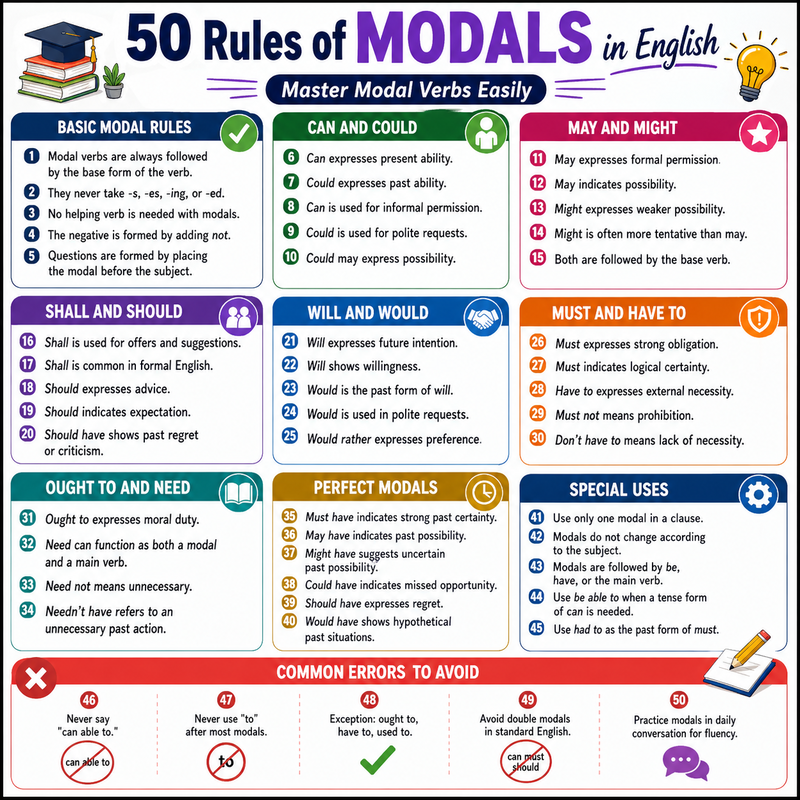

Modal verbs are helping verbs that express ability, possibility, permission, obligation, advice, and necessity. Here are 50 essential rules to help you understand and use them correctly.
Basic Modal Rules
Modal verbs are always followed by the base form of the verb.
They never take -s, -es, -ing, or -ed.
No helping verb is needed with modals.
The negative is formed by adding not.
Questions are formed by placing the modal before the subject.
Can and Could
Can expresses present ability.
Could expresses past ability.
Can is used for informal permission.
Could is used for polite requests.
Could may express possibility.
May and Might
May expresses formal permission.
May indicates possibility.
Might expresses weaker possibility.
Might is often more tentative than may.
Both are followed by the base verb.
Shall and Should
Shall is used for offers and suggestions.
Shall is common in formal English.
Should expresses advice.
Should indicates expectation.
Should have shows past regret or criticism.
Will and Would
Will expresses future intention.
Will shows willingness.
Would is the past form of will.
Would is used in polite requests.
Would rather expresses preference.
Must and Have To
Must expresses strong obligation.
Must indicates logical certainty.
Have to expresses external necessity.
Must not means prohibition.
Don't have to means lack of necessity.
Ought To and Need
Ought to expresses moral duty.
Need can function as both a modal and a main verb.
Need not means unnecessary.
Needn't have refers to an unnecessary past action.
Perfect Modals
Must have indicates strong past certainty.
May have indicates past possibility.
Might have suggests uncertain past possibility.
Could have indicates missed opportunity.
Should have expresses regret.
Would have shows hypothetical past situations.
Special Uses
Use only one modal in a clause.
Modals do not change according to the subject.
Modals are followed by be, have, or the main verb.
Use be able to when a tense form of can is needed.
Use had to as the past form of must.
Common Errors to Avoid
Never say "can able to."
Never use "to" after most modals.
Exception: ought to, have to, used to.
Avoid double modals in standard English.
Practice modals in daily conversation for fluency.

Comments
No comments yet. Be the first to comment!