

50 Important Rules of Conjunctions
Easy Grammar Rules for Better English Writing and Speaking
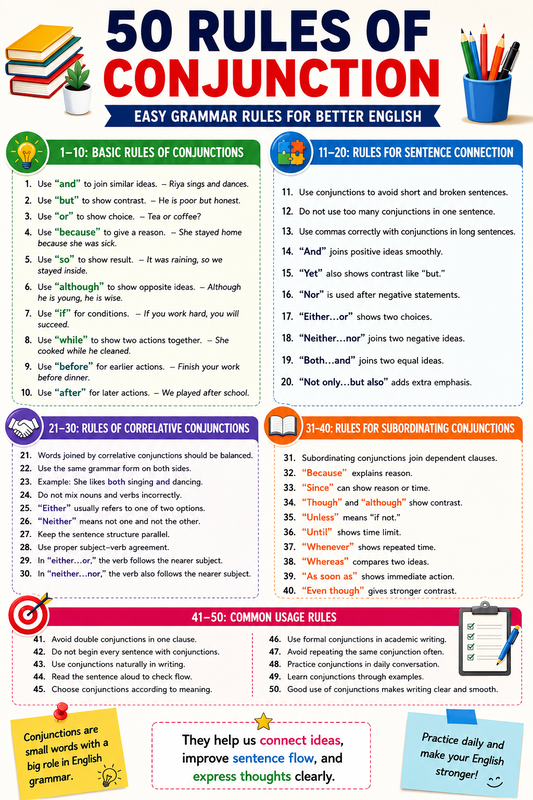

Conjunctions are joining words. They connect words, phrases, clauses, or sentences. Common conjunctions are and, but, or, because, although, if, and so. Learning their rules helps us write and speak clearly.
1–10: Basic Rules of Conjunctions
Use “and” to join similar ideas.
Example: Riya sings and dances.
Use “but” to show contrast.
Example: He is poor but honest.
3.Use “or” to show choice.
Example: Tea or coffee?
Use “because” to give a reason.
Example: She stayed home because she was sick.
Use “so” to show result.
Example: It was raining, so we stayed inside.
6.Use “although” to show opposite ideas.
Example: Although he is young, he is wise.
Use “if” for conditions.
Example: If you work hard, you will succeed.
Use “while” to show two actions together.
Example: She cooked while he cleaned.
Use “before” for earlier actions.
Example: Finish your work before dinner.
Use “after” for later actions.
Example: We played after school.
11–20: Rules for Sentence Connection
Use conjunctions to avoid short and broken sentences.
Do not use too many conjunctions in one sentence.
Use commas correctly with conjunctions in long sentences.
“And” joins positive ideas smoothly.
“Yet” also shows contrast like “but.”
“Nor” is used after negative statements.
“Either…or” shows two choices.
“Neither…nor” joins two negative ideas.
“Both…and” joins two equal ideas.
“Not only…but also” adds extra emphasis.
21–30: Rules of Correlative Conjunctions
Words joined by correlative conjunctions should be balanced.
Use the same grammar form on both sides.
Example: She likes both singing and dancing.
Do not mix nouns and verbs incorrectly.
“Either” usually refers to one of two options.
“Neither” means not one and not the other.
Keep the sentence structure parallel.
Use proper subject-verb agreement.
In “either…or,” the verb follows the nearer subject.
In “neither…nor,” the verb also follows the nearer subject.
31–40: Rules for Subordinating Conjunctions
Subordinating conjunctions join dependent clauses.
“Because” explains reason.
“Since” can show reason or time.
“Though” and “although” show contrast.
“Unless” means “if not.”
“Until” shows time limit.
“Whenever” shows repeated time.
“Whereas” compares two ideas.
“As soon as” shows immediate action.
“Even though” gives stronger contrast.
41–50: Common Usage Rules
Avoid double conjunctions in one clause.
Do not begin every sentence with conjunctions.
Use conjunctions naturally in writing.
Read the sentence aloud to check flow.
Choose conjunctions according to meaning.
Use formal conjunctions in academic writing.
Avoid repeating the same conjunction often.
Practice conjunctions in daily conversation.
Learn conjunctions through examples.
Good use of conjunctions makes writing clear and smooth.
Conclusion
Conjunctions are small words with a big role in English grammar. They help us connect ideas, improve sentence flow, and express thoughts clearly. By learning and practicing these 50 rules, students can improve both writing and speaking skills with confidence.

Comments
No comments yet. Be the first to comment!