

50 Simple Rules of Verbs in English Grammar
Easy Grammar Guide for Everyday English 🌟
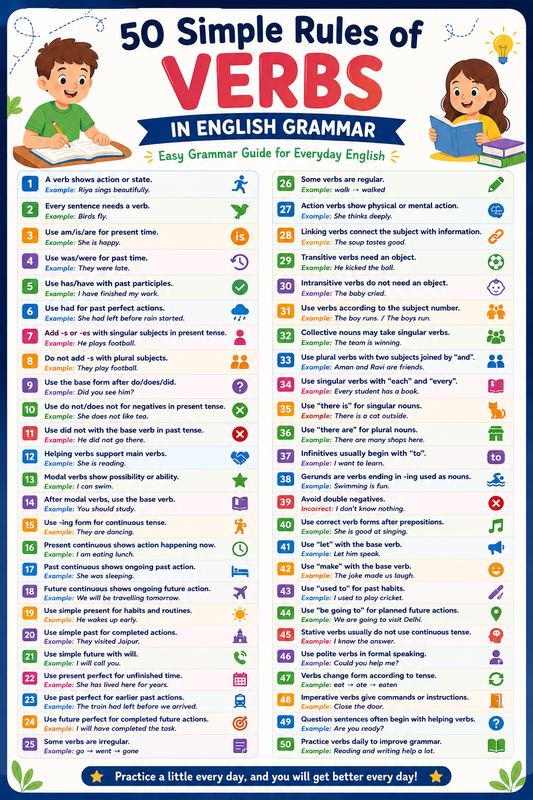

📘 50 Simple Rules of Verbs in English Grammar
1. A verb shows action or state.
Example: Riya sings beautifully.
2. Every sentence needs a verb.
Example: Birds fly.
3. Use am/is/are for present time.
Example: She is happy.
4. Use was/were for past time.
Example: They were late.
5. Use has/have with past participles.
Example: I have finished my work.
6. Use had for past perfect actions.
Example: She had left before rain started.
7. Add -s or -es with singular subjects in present tense.
Example: He plays football.
8. Do not add -s with plural subjects.
Example: They play football.
9. Use the base form after do/does/did.
Example: Did you see him?
10. Use do not/does not for negatives in present tense.
Example: She does not like tea.
11. Use did not with the base verb in past tense.
Example: He did not go there.
12. Helping verbs support main verbs.
Example: She is reading.
13. Modal verbs show possibility or ability.
Example: I can swim.
14. After modal verbs, use the base verb.
Example: You should study.
15. Use -ing form for continuous tense.
Example: They are dancing.
16. Present continuous shows action happening now.
Example: I am eating lunch.
17. Past continuous shows ongoing past action.
Example: She was sleeping.
18. Future continuous shows ongoing future action.
Example: We will be travelling tomorrow.
19. Use simple present for habits and routines.
Example: He wakes up early.
20. Use simple past for completed actions.
Example: They visited Jaipur.
21. Use simple future with will.
Example: I will call you.
22. Use present perfect for unfinished time.
Example: She has lived here for years.
23. Use past perfect for earlier past actions.
Example: The train had left before we arrived.
24. Use future perfect for completed future actions.
Example: I will have completed the task.
25. Some verbs are irregular.
Example: go → went → gone
26. Some verbs are regular.
Example: walk → walked
27. Action verbs show physical or mental action.
Example: She thinks deeply.
28. Linking verbs connect the subject with information.
Example: The soup tastes good.
29. Transitive verbs need an object.
Example: He kicked the ball.
30. Intransitive verbs do not need an object.
Example: The baby cried.
31. Use verbs according to the subject number.
Example: The boy runs. / The boys run.
32. Collective nouns may take singular verbs.
Example: The team is winning.
33. Use plural verbs with two subjects joined by “and”.
Example: Aman and Ravi are friends.
34. Use singular verbs with “each” and “every”.
Example: Every student has a book.
35. Use “there is” for singular nouns.
Example: There is a cat outside.
36. Use “there are” for plural nouns.
Example: There are many shops here.
37. Infinitives usually begin with “to”.
Example: I want to learn.
38. Gerunds are verbs ending in -ing used as nouns.
Example: Swimming is fun.
39. Avoid double negatives.
Incorrect: I don’t know nothing.
40. Use correct verb forms after prepositions.
Example: She is good at singing.
41. Use “let” with the base verb.
Example: Let him speak.
42. Use “make” with the base verb.
Example: The joke made us laugh.
43. Use “used to” for past habits.
Example: I used to play cricket.
44. Use “be going to” for planned future actions.
Example: We are going to visit Delhi.
45. Stative verbs usually do not use continuous tense.
Example: I know the answer.
46. Use polite verbs in formal speaking.
Example: Could you help me?
47. Verbs change form according to tense.
Example: eat → ate → eaten
48. Imperative verbs give commands or instructions.
Example: Close the door.
49. Question sentences often begin with helping verbs.
Example: Are you ready?
50. Practice verbs daily to improve grammar.
Example: Reading and writing help a lot.

Comments
No comments yet. Be the first to comment!