
Master Pronouns Easily
50 Simple Pronoun Rules for Better English

Pronoun Rules for Better English
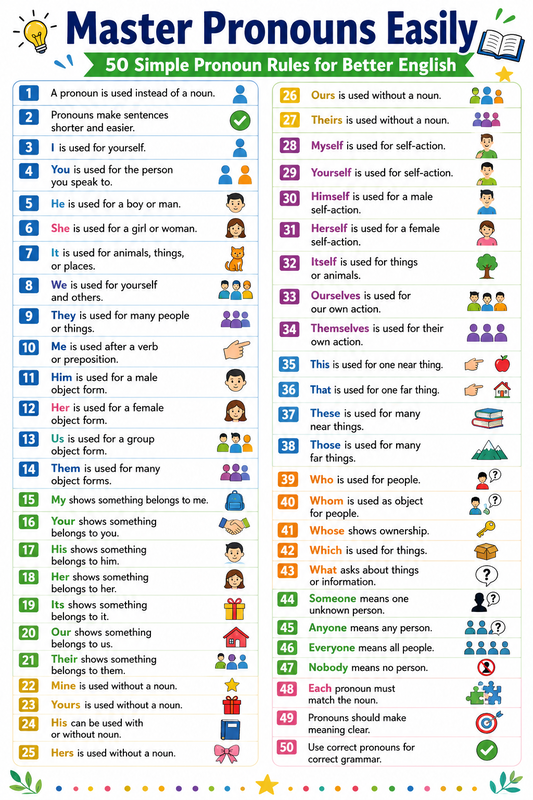
A pronoun is used instead of a noun.
Pronouns make sentences shorter and easier.
I is used for yourself.
You is used for the person you speak to.
He is used for a boy or man.
She is used for a girl or woman.
It is used for animals, things, or places.
We is used for yourself and others.
They is used for many people or things.
Me is used after a verb or preposition.
Him is used for a male object form.
Her is used for a female object form.
Us is used for a group object form.
Them is used for many object forms.
My shows something belongs to me.
Your shows something belongs to you.
His shows something belongs to him.
Her shows something belongs to her.
Its shows something belongs to it.
Our shows something belongs to us.
Their shows something belongs to them.
Mine is used without a noun.
Yours is used without a noun.
His can be used with or without noun.
Hers is used without a noun.
Ours is used without a noun.
Theirs is used without a noun.
Myself is used for self-action.
Yourself is used for self-action.
Himself is used for a male self-action.
Herself is used for a female self-action.
Itself is used for things or animals.
Ourselves is used for our own action.
Themselves is used for their own action.
This is used for one near thing.
That is used for one far thing.
These is used for many near things.
Those is used for many far things.
Who is used for people.
Whom is used as object for people.
Whose shows ownership.
Which is used for things.
What asks about things or information.
Someone means one unknown person.
Anyone means any person.
Everyone means all people.
Nobody means no person.
Each pronoun must match the noun
Pronouns should make meaning clear.
Use correct pronouns for correct grammar.

Comments
No comments yet. Be the first to comment!