

Essential Rules of English Grammar Nouns
Simple and Easy Noun Rules to Improve Your English Speaking and Writing
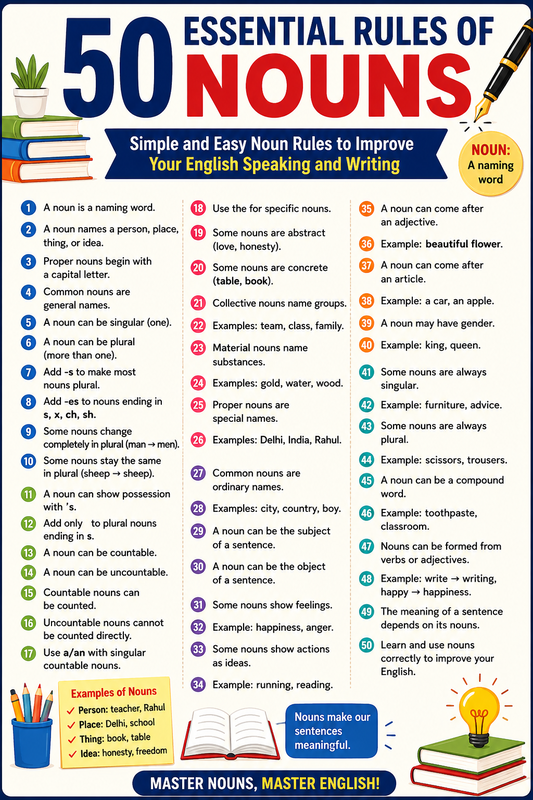

Here are some basic rules of nouns in English in simple language:
A noun is a naming word.
A noun names a person, place, thing, or idea.
Proper nouns begin with a capital letter.
Common nouns are general names.
A noun can be singular (one).
A noun can be plural (more than one).
Add -s to make most nouns plural.
Add -es to nouns ending in s, x, ch, sh.
Some nouns change completely in plural (man → men).
Some nouns stay the same in plural (sheep → sheep).
A noun can show possession with 's.
Add only ' to plural nouns ending in s.
A noun can be countable.
A noun can be uncountable.
Countable nouns can be counted.
Uncountable nouns cannot be counted directly.
Use a/an with singular countable nouns.
Use the for specific nouns.
Some nouns are abstract (love, honesty).
Some nouns are concrete (table, book).
Collective nouns name groups.
Examples: team, class, family.
Material nouns name substances.
Examples: gold, water, wood.
Proper nouns are special names.
Examples: Delhi, India, Rahul.
Common nouns are ordinary names.
Examples: city, country, boy.
A noun can be the subject of a sentence.
A noun can be the object of a sentence.
Some nouns show feelings.
Example: happiness, anger.
Some nouns show actions as ideas.
Example: running, reading.
A noun can come after an adjective.
Example: beautiful flower.
A noun can come after an article.
Example: a car, an apple.
A noun may have gender.
Example: king, queen.
Some nouns are always singular.
Example: furniture, advice.
nouns are always plural.
Example: scissors, trousers.
A noun can be a compound word.
Example: toothpaste, classroom.

Comments
No comments yet. Be the first to comment!