

Core fundamental of subject- verb aggreement
Learn the basics of making simple sentences
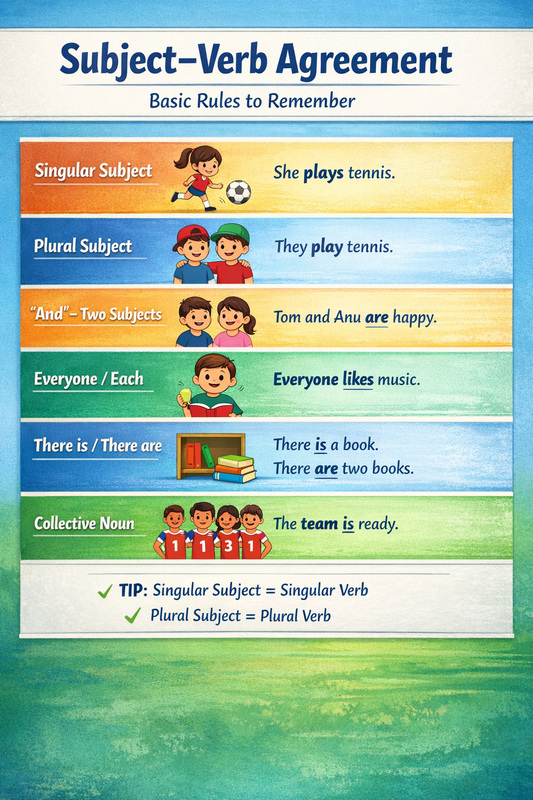

Subject–Verb Agreement is one of the most important parts of English grammar. It means that the subject and the verb in a sentence must match in number. If the subject is singular, the verb should also be singular. If the subject is plural, the verb should also be plural.
Learning these basic rules helps us speak and write correct English.
1. Singular Subject Takes a Singular Verb
When the subject is one person, place, or thing, we use a singular verb.
Examples:
She plays football.
The boy runs fast.
My brother likes tea.
2. Plural Subject Takes a Plural Verb
When the subject is more than one, we use a plural verb.
Examples:
They play football.
The boys run fast.
My friends like tea.
3. Two Subjects Joined by “And”
When two subjects are connected with and, we usually use a plural verb.
Examples:
Ram and Shyam are friends.
Tea and coffee are available here.
4. Words Like Everyone, Someone, Each
Words such as everyone, someone, each, everyone, anybody are singular. So they take a singular verb.
Examples:
Everyone likes music.
Each student has a book.
Somebody is calling you.
5. “There is” and “There are”
Use there is for singular and there are for plural.
Examples:
There is a book on the table.
There are many books on the table.
6. Collective Nouns
Words like team, family, group, class are usually treated as singular.
Examples:
The team is playing well.
My family lives in Jaipur.
Conclusion
Subject–Verb Agreement is the foundation of correct English sentences. By remembering a few simple rules, we can avoid many grammar mistakes. Practice these rules while speaking and writing, and your English will become clearer and more confid

Comments
No comments yet. Be the first to comment!