

50 Important Rules of Modals in English Grammar
Master Modals Easily and Speak Confidently
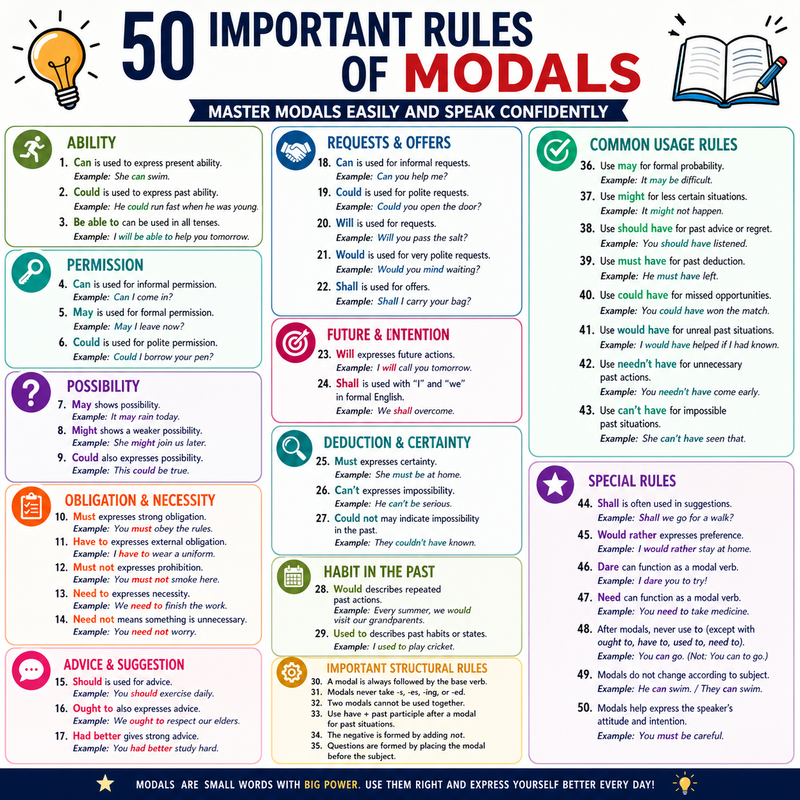

What Are Modals?
Modals are helping verbs used to express ability, possibility, permission, obligation, advice, and more. They are always followed by the base form of the main verb.
Ability
Can is used to express present ability. Example: She can swim.
Could is used to express past ability. Example: He could run fast when he was young.
3.Be able to can be used in all tenses.
Example: I will be able to help you tomorrow.
Permission
Can is used for informal permission.
Example: Can I come in?
May is used for formal permission.
Example: May I leave now?
Could is used for polite permission.
Example: Could I borrow your pen?
Possibility
May shows possibility.
Example: It may rain today.
Might shows a weaker possibility.
Example: She might join us later.
9.Could also expresses possibility.
Example: This could be true.
Obligation and Necessity
10.. Must expresses strong obligation.
Example: You must obey the rules.
Have to expresses external obligation.
Example: I have to wear a uniform.
Must not expresses prohibition.
Example: You must not smoke here.
13.Need to expresses necessity.
Example: We need to finish the work.
Need not means something is unnecessary.
Example: You need not worry.
Advice and Suggestion
Should is used for advice.
Example: You should exercise daily.
Ought to also expresses advice.
Example: We ought to respect our elders.
Had better gives strong advice.
Example: You had better study hard.
Requests and Offers
18.Can is used for informal requests.
Example: Can you help me?
Could is used for polite requests.
Example: Could you open the door?
Will is used for requests.
Example: Will you pass the salt?
Would is used for very polite requests.
Example: Would you mind waiting?
Shall is used for offers.
Example: Shall I carry your bag?
Future and Intention
Will expresses future actions.
Example: I will call you tomorrow.
Shall is used with "I" and "we" in formal English.
Example: We shall overcome.
Deduction and Certainty
Must expresses certainty.
Example: She must be at home.
Can't expresses impossibility.
Example: He can't be serious.
Could not may indicate impossibility in the past.
Example: They couldn't have known.
Habit in the Past
Would describes repeated past actions.
Example: Every summer, we would visit our grandparents.
Used to describes past habits or states.
Example: I used to play cricket.
Important Structural Rules
A modal is always followed by the base verb.
Modals never take -s, -es, -ing, or -ed.
Two modals cannot be used together.
Use have + past participle after a modal for past situations.
The negative is formed by adding not.
Questions are formed by placing the modal before the subject.
Common Usage Rules
Use may for formal probability.
Use might for less certain situations.
Use should have for past advice or regret.
Use must have for past deduction.
Use could have for missed opportunities.
Use would have for unreal past situations.
Use needn't have for unnecessary past actions.
Use can't have for impossible past situations.
Special Rules
Shall is often used in suggestions.
Would rather expresses preference.
Dare can function as a modal verb.
Need can function as a modal verb.
After modals, never use to (except with ought to, have to, used to, need to).
Modals do not change according to subject.
Modals help express the speaker's attitude and intention.l

Comments
No comments yet. Be the first to comment!