

SIMPLE PAST TENSE
Learn How to Talk About Completed Actions in the Past
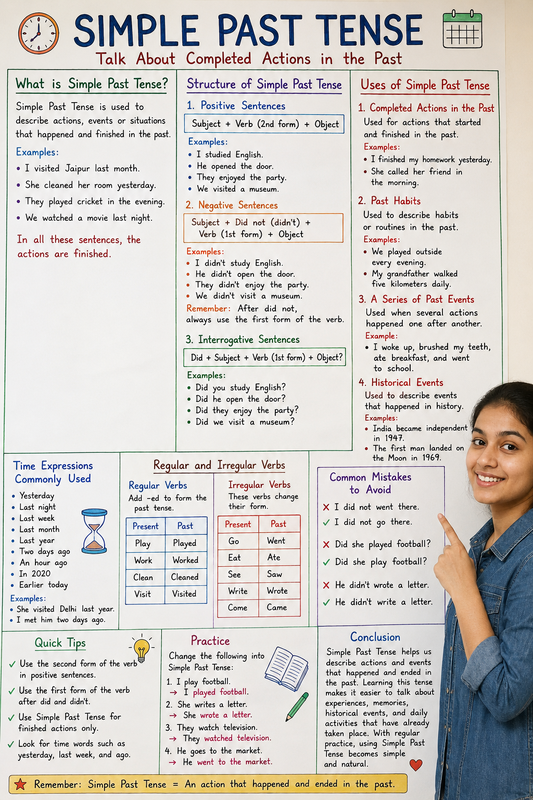

Introduction
Simple Past Tense is one of the most commonly used tenses in English grammar. It is used to describe actions, events, or situations that happened and finished in the past. The action is completely over and has no direct connection with the present time.
What is Simple Past Tense?
Simple Past Tense tells us about something that happened before now and has already ended.
Examples:
I visited Jaipur last month.
She cleaned her room yesterday.
They played cricket in the evening.
We watched a movie last night.
In all these sentences, the actions are finished.
Structure of Simple Past Tense
1. Positive Sentences
Subject + Verb (2nd Form) + Object
Examples:
I studied English.
He opened the door.
They enjoyed the party.
We visited a museum.
2. Negative Sentences
Subject + Did Not (Didn't) + Verb (1st Form) + Object
Examples:
I didn't study English.
He didn't open the door.
They didn't enjoy the party.
We didn't visit a museum.
Remember: After did not, always use the first form of the verb.
3. Interrogative Sentences
Did + Subject + Verb (1st Form) + Object?
Examples:
Did you study English?
Did he open the door?
Did they enjoy the party?
Did we visit a museum?
Uses of Simple Past Tense
1. Completed Actions in the Past
Used for actions that started and finished in the past.
Examples:
I finished my homework yesterday.
She called her friend in the morning.
2. Past Habits
Used to describe habits or routines in the past.
Examples:
We played outside every evening.
My grandfather walked five kilometers daily.
3. A Series of Past Events
Used when several actions happened one after another.
Example:
I woke up, brushed my teeth, ate breakfast, and went to school.
4. Historical Events
Used to describe events that happened in history.
Examples:
India became independent in 1947.
The first man landed on the Moon in 1969.
Time Expressions Commonly Used
Yesterday
Last night
Last week
Last month
Last year
Two days ago
An hour ago
In 2020
Earlier today
Examples:
She visited Delhi last year.
I met him two days ago.
Regular and Irregular Verbs
Regular Verbs
Add -ed to form the past tense.
Present. Past
Play. Played
Work. Worked
Clean. Cleaned
Visit. Visited
Irregular Verbs
These verbs change their form.
Present. Past
Go. Went
Eat. Ate
See. Saw
Write. Wrote
Come. Came
Common Mistakes to Avoid
❌ I did not went there.
✅ I did not go there.
❌ Did she played football?
✅ Did she play football?
❌ He didn't wrote a letter.
✅ He didn't write a letter.
Quick Tips
✔ Use the second form of the verb in positive sentences.
✔ Use the first form of the verb after did and didn't.
✔ Use Simple Past Tense for finished actions only.
✔ Look for time words such as yesterday, last week, and ago.
Practice Sentences
Change the following into Simple Past Tense:
I play football. → I played football.
She writes a letter. → She wrote a letter.
They watch television. → They watched television.
He goes to the market. → He went to the market.
Conclusion
Simple Past Tense helps us describe actions and events that happened and ended in the past. Learning this tense makes it easier to talk about experiences, memories, historical events, and daily activities that have already taken place. With regular practice, using Simple Past Tense becomes simple and natural.

Comments
No comments yet. Be the first to comment!